


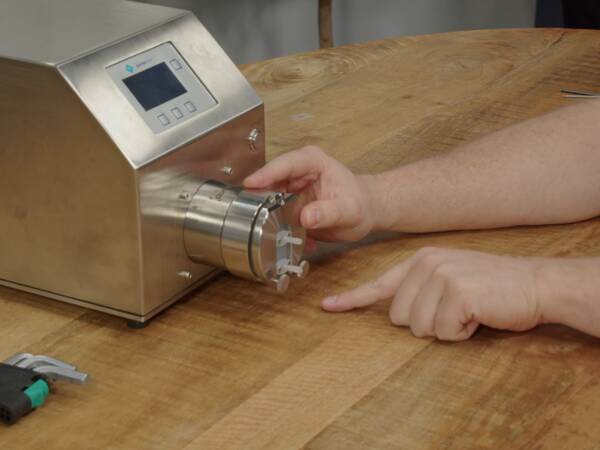
In practice, maintenance issues with Quattroflow pumps rarely start with a complete failure. More often, you notice small warning signs first: unstable flow during filtration, minor leakage around the diaphragm housing, or a pump that gradually loses accuracy over time. I have noticed that the underlying cause is generally that insufficient maintenance was performed on the pump. But how do you know when to perform maintenance and which pump parts to inspect?
What makes Quattroflow pumps different from conventional diaphragm pumps?
To understand the correct maintenance method for Quattroflow pumps, we must first look at the differences between these pumps and conventional diaphragm pumps. Unlike conventional diaphragm pumps, Quattroflow pumps use a 4-piston diaphragm design in which multiple diaphragm chambers operate sequentially to create a low-pulsation flow. This reduces shear stress and improves flow stability, which is particularly important in biopharma applications such as TFF, chromatography, and cell culture processes.
Because the product chamber contains no rotating parts, mechanical stress on the fluid remains low. The video next to this paragraph from our supplier CPC Biotech explains the differences in more detail.
For maintenance, this means wear often develops gradually rather than through sudden failure. Diaphragms, valves, and bearings may continue operating while flow accuracy and pressure stability slowly decline. As a result, effective maintenance depends heavily on preventive inspection and timely replacement of wear-sensitive components.
The risks of insufficient maintenance
Quattroflow pumps are used in critical processes like tangential flow filtration (TFF), chromatography, buffer and media transfer, cell culture applications, and sterile filtration, where product loss is expensive and contamination control is crucial. In these environments, insufficient maintenance can have major operational consequences.
Gradual diaphragm wear, valve fatigue, or bearing degradation can eventually lead to leakage if components are not inspected or replaced in time. Leakage is, of course, a contamination risk that must be avoided at all times. In more severe cases, leakage and corrosion may even damage the pump head or motor, resulting in costly repairs or complete replacement.
Pump performance can also deteriorate gradually without being immediately visible during daily operation. Wear of internal components may affect pump consistency and pressure stability, leading to irregular flow patterns, increased pulsation, or reduced dosing accuracy. When these issues escalate, they can result in unplanned downtime, batch deviations, and potential non-conformance with GMP or other regulatory requirements
How to know when maintenance is necessary
In practice, (preventive) maintenance is often postponed longer than it should be, often because companies are unsure about the recommended maintenance intervals or because they underestimate the long-term consequences of insufficient maintenance.
Under standard operating conditions, the pump chamber and shaft-bearing-cap (WLC) unit should be replaced after 1.000 operating hours or at least once per year. Higher temperatures, aggressive fluids, or demanding operating conditions may require more frequent inspection and replacement of wear-sensitive components.
Apart from regular preventive maintenance, you should pay attention to warning signs that indicate maintenance may already be necessary. Such signs are:
- Leakage around the diaphragm housing or pump chamber
- Excessive vibration
- Unusual noise
- Irregular flow patterns
- Increased pulsation
- Lower-than-expected flow rate
These issues may indicate wear of diaphragms, valves, or bearings. The key is not to wait for complete failure. In many cases, pump performance starts deteriorating long before major leakage or downtime occurs. Regular inspection and preventive replacement of wear-sensitive components help maintain stable flow performance and reduce the risk of contamination, production interruptions, and costly repairs.
Which types of maintenance should you perform – and when?
The type of maintenance required depends heavily on the issue you are experiencing. Upon inspection of the pump parts, some issues can be solved through tightening a loose component or altering operational conditions, while others require complete replacement. The table below shows the most common maintenance-related issues in Quattroflow pumps and the recommended maintenance actions for each situation.
Common mistakes to avoid during maintenance
All regular maintenance tasks on Quattroflow pumps can be performed in-house, but it is important to pay close attention to a few common mishaps. Incorrect reassembly of the pump chamber or internal components after inspection or replacement can lead to the very issues you were trying to solve in the first place.
Think of incorrect alignment, improperly mounted diaphragms, or insufficiently tightened screws and clamps. Insufficient cleaning before or after maintenance is another important risk, especially in biopharma environments. Another common mistake is using incompatible, non-original, or non-validated spare parts. Incorrect diaphragms, elastomers, or replacement components may affect chemical compatibility, pump performance, and GMP compliance. In GMP-regulated environments, maintenance activities should also be documented properly to ensure traceability of inspections, cleaning activities, and replaced components.
While many maintenance tasks are relatively straightforward, process-critical applications or recurring performance issues may still require validated procedures or manufacturer support.
In many cases, Quattroflow pump failures do not occur suddenly. Leakage, pulsation issues, and performance degradation typically develop gradually through diaphragm wear, bearing degradation, or process stress. By performing preventive inspections, recognizing early warning signs, and replacing wear-sensitive components in time, you can maintain stable pump performance, reduce contamination risks, and avoid unnecessary downtime or costly repairs. Questions about maintenance intervals, spare parts, or recurring pump issues? Feel free to contact me.